Complex layering
Live-composition technique
Complex layering is rooted in the idea of combining several voices canons with improvisation. Inspired by the hyper-complex polyphonic techniques of the Franco-Flemish school (Ockeghem, Josquin), it leaves to the performer complete agency over the structure of the piece.
<——— listen to this excerpt

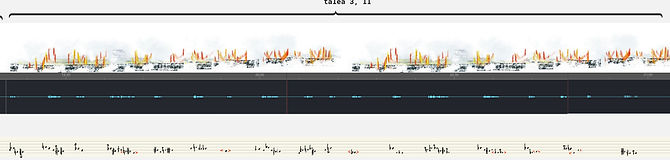
This score shows the head of the canon (talea): a recorded female voice reading a text in Hungarian.
The sound wave of the recording are shown alongside the pitches contained in the speech and a graphic representation of the voice itself.
The talea is repeated several times, with more and more silence in between the sounds.
The performer improvises on the recording using the material shown by the score. Using a loop station, fragments of the voice and the improvisation are over imposed over the reiteration of the talea creating the canon.
This is an example of asemic writing used in complex layering. Asemic writing is defined as a form of writing that does not hold any predetermined or fixed semantic meaning.
This particular line is the asemic transcription of a female voice reading a text in Japanese.

<——— listen to this excerpt

This score shows a different talea: a recorded female voice reading a poem in Spanish.
Each speech has its own colour, its own pitch-set and pace. The score aims at providing jumping-off points for the musician to access her/his own perception of the universe contained in that particular and unrepeatable human voice.

Pitch notation
When we speak, our voice fluctuates in microtonal clouds, going back and forth, touching and resting on recurring pitches.
Some of these pitches become more evident than others depending on how much space or importance we give to certain fragments of a word, or to certain vowels, i.e. depending on the inner meaning that we’re conveying.
I’m interested in developing a simple pitch notation that would be able to capture these nuances, whilst leaving to the performer a wide range of freedom in the improvisation.
The example below shows a fragment of a female voice speaking in polish.

Listen to this excerpt:
The notation shows the pitches that are most recognisable within the speach.
When a discrete pitch is reported on the score, the performer is free of using the whole palette of timbres and colours that her/his instrument provides to improvise on it, always listening to the voice first.
The red brackets < > emphasise the microtonally rich quality of a specific group of pitches.
The performer can improvise using any microtonal variation of that group:

Other examples of asemic writing

E. Biagi
”Lectures”
50x70
Chalk, acrylic, ink, engravings on paper
Details


E. Biagi
”Interview”
60x90
Chalk and ink on paper-board

